
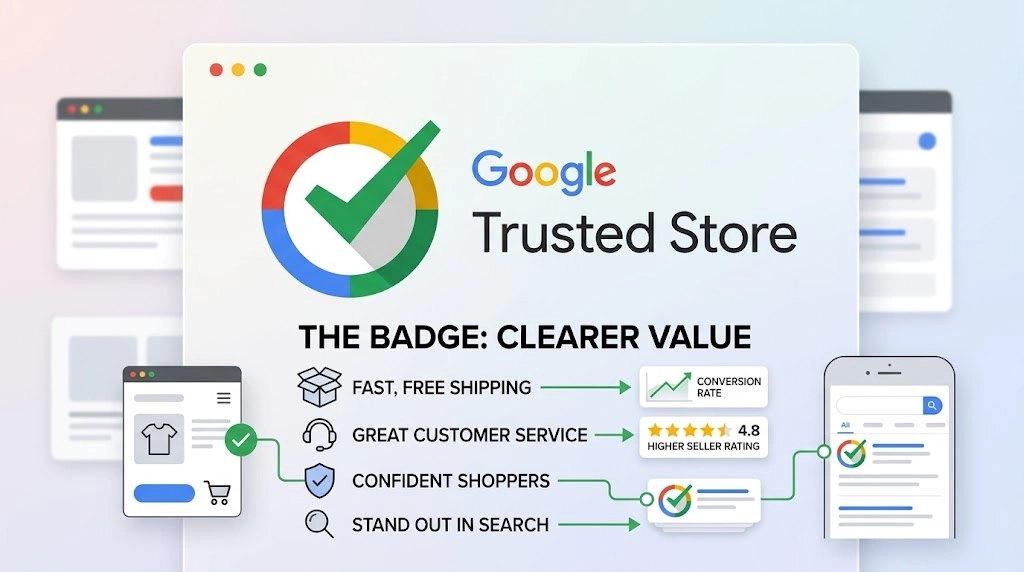
You are two clicks from paying. Somewhere near the checkout button there is a small blue and white badge that says "Google Trusted Store". Your shoulders drop half an inch. Google checked this place out, so it must be fine.
Here is the problem. Google stopped running that programme in the spring of 2017. There is no Google Trusted Stores certification any more, no verification page, and no purchase protection behind it. Which means any badge carrying that name on a live store in 2026 is a picture someone saved and uploaded.
That does not automatically make the store a scam. Plenty of small retailers inherited the badge from an old theme and never noticed. But it does mean the badge is telling you nothing, and it is worth knowing what a real trust signal looks like instead.
The short answer
| Question | Answer |
| Is Google Trusted Stores still running? | No. Merchants were notified in March 2017 and the programme was retired in April 2017. |
| Does the badge mean Google vetted the store? | Not in 2026. It cannot, because Google no longer certifies anyone under that name. |
| Is there still purchase protection? | No. The consumer protection side was retired with the programme. |
| Can the badge be verified? | No. The old verification address now just bounces to the Google homepage. |
| What replaced it? | Google Customer Reviews in 2017, and later the Top Quality Store badge in Google Shopping. |
What Google Trusted Stores actually was
It was a real thing, and for a while it was genuinely useful. Google opened it in beta in October 2011 with around 50 online stores, then launched it publicly on 7 June 2012, free, for US merchants only.
Google vetted merchants on shipping reliability and customer service, then gave each one a public report card. The badge, in Google's own words at the time, was only awarded to online stores that delivered a good overall experience.
The part nobody replicates today: Google backed it with up to $1,000 in lifetime purchase protection per shopper, funded by Google itself. If a certified store took your money and never delivered, you had somewhere to go.
That is the detail worth holding on to. Nothing Google runs today carries a purchase guarantee. Not Google Customer Reviews, not the Top Quality Store badge, nothing. When a shop shows you an old Trusted Stores badge, it is borrowing the credibility of a guarantee that no longer exists.
When it died, and what took its place
| Date | What happened |
| Oct 2011 | Google Trusted Stores opens in beta with roughly 50 stores |
| 7 Jun 2012 | Public launch, free, US merchants, up to $1,000 lifetime purchase protection |
| 6 Mar 2017 | Google emails merchants that the programme is shutting down |
| Apr 2017 | Programme retired. Google Customer Reviews launches as the replacement, described by Google as not a certification programme |
| 29 Mar 2022 | Google launches a new Shopping badge, confusingly also called Trusted Store |
| 25 May 2023 | That badge is renamed Top Quality Store |
| 2026 | Google Customer Reviews and Top Quality Store are both live. Trusted Stores has been gone for nine years |
Google never published a hard shutdown date, so if you see this written up anywhere the honest framing is announced March 2017, retired April 2017.
Why a Trusted Store badge in 2026 is always a static image
This is the part you can check yourself, and it is the whole argument in one line.
A real trust badge is served live by the organisation that issues it. Your browser loads it from their servers, and clicking it takes you to a page on their domain showing that specific merchant's status. That round trip is the entire point of a badge.
Google Trusted Stores has had no verification endpoint since 2017. The old address at google.com/trustedstores now simply redirects to google.com. The shopping.google.com version returns a 404. There is nothing left to verify against.
So the logic is closed: Google does not issue a Trusted Stores badge, therefore no site can be serving a live one, therefore every one you see is a copied image file sitting in someone's uploads folder.
Stale advice keeps it alive. SEO blogs were still publishing step-by-step guides on how to become a Google Trusted Store as recently as 2024, seven years after the programme ended, and merchants are still filing support tickets asking how to strip leftover Trusted Stores code out of their themes.
What Google Customer Reviews actually is
This is the real, current programme, and the badge it produces is a live one. If you are going to trust a Google badge on a store, this is the one to look for.
| Item | Detail |
| What it is | A Merchant Center programme that collects post-purchase feedback through an opt-in box on the order confirmation page |
| Cost to the store | Free |
| How a store qualifies | Needs an order confirmation page and must verify ownership of its domain in Merchant Center |
| How reviews are collected | If a shopper opts in, Google emails them a survey after the estimated delivery date |
| Who can review | Only people who actually placed an order |
| Reviews needed for a star rating | Around 100 eligible reviews in most cases |
| Below that threshold | The badge still shows, but reads "Rating not available" |
| Availability | More than 90 countries |
Read the badge carefully. A Google Customer Reviews badge showing "Rating not available" is not a seal of approval. It means the store has signed up and has not collected enough verified reviews yet. Google lets the badge display with no minimum rating at all, so a store with a mediocre score still gets to show it.
The seller star ratings you see in Google Ads and listings work on similar rules: 100 or more eligible reviews, and text ads need an average of 3.5 stars or higher. Those ratings are country specific, so reviews collected in one country do not prop up another. They also pull from more than 30 independent review partners including Trustpilot, Yotpo, Feefo, Reviews.io and Bazaarvoice, not just Google's own survey.
One inconsistency worth knowing about: Google's own help pages disagree on whether the review window is 12 months or 24 months. Both pages are current. Nobody has reconciled it publicly.
Top Quality Store, the badge people actually confuse it with
In March 2022 Google launched a new badge in Shopping and, for reasons known only to Google, called it the Trusted Store badge. It was renamed Top Quality Store in May 2023. That rename is a large part of why the old name keeps circulating.
Today it sits inside Google's Store Quality programme. To earn it, a merchant has to rank Exceptional on the overall quality score, which is the top tier above Low, Fair, Good and Great, across four areas: shipping experience, return experience, browsing experience and purchase experience.
That is a genuinely meaningful bar. But Google is blunt about its limits, and this line is worth quoting to anyone who waves a badge at you:
"Google does not guarantee the reliability of any merchant or its products, and does not offer any purchase protection if you are dissatisfied with a merchant."
Merchants are allowed to display it on their own site, but under strict rules. Clear space of at least half the badge height on all sides. The merchant's own branding has to be larger and more prominent. No recolouring, no distorting, no resizing, no building it into a logo, no implying a partnership with Google.
Which gives you a free tell: a stretched, off-colour or oddly cropped Google badge is by definition a misused one, because the real rules forbid exactly that.
Other badges that are already dead
Trusted Stores is not the only zombie on the internet. If you find one of these, the site has not audited its own footer in years.
| Badge | Status | Detail |
| Norton Secured | Retired 17 Oct 2023 | Descended from VeriSign and Symantec to DigiCert. Replaced by the DigiCert Smart Seal |
| McAfee SECURE | Retired 30 Jun 2021 | Began life as the ScanAlert "HACKER SAFE" mark. Now TrustedSite Certification, which is still live |
| SSL Secured graphics | Meaningless | HTTPS is free and universal. Browsers removed the green EV bar between 2018 and 2019, so an on-page padlock image proves nothing |
| TRUSTe / TrustArc | Live, with history | Settled with the FTC for $200,000 in November 2014 after failing to run promised annual recertifications in over 1,000 cases between 2006 and 2013 |
| Trustwave Trusted Commerce | Live | Verification server still responding. Trustwave was acquired by LevelBlue in August 2025 |
| BBB Accredited Business | Live, widely misused | Only licensed businesses may display it. BBB pursues infringers, but plenty of sites use the torch logo without accreditation |
The TRUSTe case is the useful lesson here. It was a real seal from a real issuer, and the FTC still found it was not being backed by the annual checks it advertised. A seal is marketing. It is not an audit.
How to verify any badge in about sixty seconds
1. Click it. A real badge links to a verification page on the issuer's domain showing this merchant's name and status. If it does nothing, or opens a page on the shop's own domain, it is a picture.
2. Check where the image loads from. Right click, inspect. A live badge loads from the issuer's servers. A badge loading from the shop's own images folder is a copy.
3. Look the merchant up at the issuer, not at the merchant. Check a store's Google rating at google.com/shopping/customerreviews, a BBB listing at bbb.org/search, a TrustArc seal at its own validation page.
4. Use the browser padlock, not the on-page one. Click the lock in the address bar and read the issued-to domain and the validity dates. That is the only authoritative indicator left since browsers dropped the green EV bar.
5. Check how old the domain is. A polished storefront on a domain registered a few weeks ago is the oldest pattern in online retail fraud. Look it up free at lookup.icann.org.
6. Look at the badge itself. Stretched, recoloured or oddly cropped means somebody saved a JPEG.
What actually counts as a trust signal in 2026
Badges that still mean something
- Google Customer Reviews, when it shows a real numeric rating rather than Rating not available
- Top Quality Store, which requires an Exceptional Store Quality ranking
- TrustedSite Certification, the successor to McAfee SECURE
- DigiCert Smart Seal, the successor to Norton Secured
- BBB Accredited Business, but only if clicking through lands on a live BBB profile for that exact business
Signals that carry more weight than any badge
- Verified buyer reviews with real volume and recent dates. Google asks for 100 or more for a reason. Eight five-star reviews mean nothing
- A real street address, a working phone number, and a named legal entity somewhere on the site
- A return policy that names the window in days, says who pays return shipping, and does not contradict itself between the homepage and the policy page
- Recognisable payment processors at checkout rather than a bank transfer request
- A domain with some age on it
It is telling that the FTC's own consumer guidance on shopping online does not mention trust seals at all. It tells people to compare prices, check who the seller is, keep records, and treat reviews with scepticism. That is the actual checklist.
One more thing worth knowing
Since 21 October 2024 the FTC's Rule on the Use of Consumer Reviews and Testimonials has been in force. It bans fake and AI-generated reviews, reviews bought in exchange for a particular sentiment, undisclosed insider reviews, company-run sites posing as independent review platforms, and suppressing negative reviews through threats. Civil penalties currently run to $53,088 per violation.
It is a genuinely strong rule. It also means a store that is casually displaying a badge for a programme that shut down in 2017 is operating in an environment where misrepresenting trust signals is a real legal exposure, not just bad taste.
FAQ
Is a Google Trusted Store badge proof of a scam?
No. It is proof of neglect. Plenty of legitimate small retailers are running a theme they bought in 2016 and have never audited the footer. Treat it as a prompt to check the other signals, not as a verdict.
What if the badge is clickable and goes somewhere?
Check where. If it lands on google.com's homepage, that is the redirect Google put in place after shutting the programme down, and it verifies nothing. If it lands on a page on the shop's own domain, that page was written by the shop.
Does Google offer any purchase protection today?
No. Google states plainly that it does not guarantee the reliability of any merchant and offers no purchase protection. Your protection comes from your card issuer or PayPal, not from Google.
How many reviews does a store need before Google shows stars?
Around 100 eligible reviews in most cases, within a rolling window, and country by country. Below that the badge shows but says Rating not available.
Is the green padlock still a thing?
No. Safari dropped the green company-name bar in September 2018, Chrome in version 77, Firefox in version 70. HTTPS now just means the connection is encrypted, which every site has for free. It says nothing about whether the shop will ship your order.
Bottom line
A Google Trusted Store badge in 2026 is a fossil. The programme it came from was genuinely good, backed by a real $1,000 guarantee, and it has been gone since spring 2017. Nothing that exists today replaces that guarantee, including the badges Google does still issue.
Judge a store on the things that cannot be copied from a Google image search: verified reviews with volume and recent dates, a real address and phone number, a return policy that agrees with itself, and a domain that has been around longer than the sale banner. Those take a store months or years to build. A badge takes ten seconds to upload.
Did you like our blog?
Comments (0)
All comments are reviewed and approved by an admin before appearing publicly.
No comments yet - be the first to share your thoughts.