
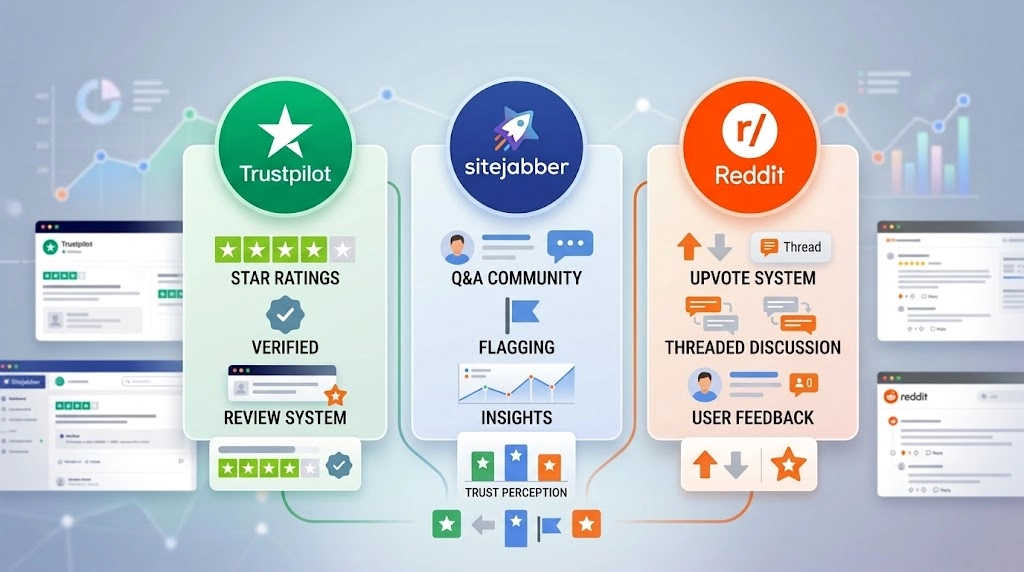
You are about to spend $200 with a brand you have never heard of. So you do what everybody does. You search the brand name plus the word reviews, and you get three kinds of result: a Trustpilot page with 4.6 stars, a Sitejabber page with a very different number, and a Reddit thread where six strangers are arguing.
Those three are not measuring the same thing, and two of them have had regulators on their case in the last two years. Here is how each one actually works, what its incentives are, and how to read all three together without getting played.
The short version
| Platform | Who pays | Biggest weakness | Best used for |
| Trustpilot | The brand, via subscription | Brands on paid plans send review invitations, which skews scores upward | Volume and patterns over time |
| Sitejabber / SmartCustomer | The brand, via paid tiers | FTC order in Nov 2024 over publishing checkout surveys as reviews | Cross-checking, with the date filter on |
| Nobody, in theory | Marketing agencies and AI reply bots | Specific problems, long-term ownership | |
| Google Reviews | Nobody | No purchase verification at all | Local and service businesses |
| Amazon | Nobody, plus free Vine units | Review hijacking via product variations | Physical products with high review counts |
Trustpilot: how it makes money, and what that does to the stars
Trustpilot is an open platform. Anyone can write a review, any business can read and reply for free. That much is true and it matters.
The money comes from a subscription. Plans run from free through Starter at $99 a month, Plus at $319, Premium at $799, and a custom Enterprise tier, billed annually per domain. What you buy climbs with the tier, and the number that matters most is review invitations per month: 50 on free, 100 on Starter, 300 on Plus, 1,000 on Premium, unlimited on Enterprise.
So the business model in one line: the more a brand pays, the more customers it can actively push into leaving a review.
Why invitations push scores up
Think about who leaves a review unprompted. Almost always someone who is annoyed. People rarely stop mid-day to praise a parcel that arrived on time.
Now add invitations. A brand emails 1,000 recent customers asking for a review. The average customer, who was fine with their order, now has a reason to click. The furious ones were going to write anyway. The result is that a stream of ordinary, satisfied, three-and-four-star-shaped experiences gets added to a pool that previously skewed negative, and the average climbs.
That is not cheating. It is arguably a fairer sample. But it means a 4.6 on a brand that pays for 1,000 invitations a month is not comparable to a 3.8 on a brand that never sends any.
Trustpilot's rules do forbid the abusive version of this. Businesses must not pick and choose which customers get invited, must not invite only people they know were happy, and must not offer any incentive at all, not discounts, not promo codes, not prize draws. Invitations are required to be fair, neutral and unbiased.
Whether that is enforced tightly enough is the open question. Academic work out of Cambridge Judge Business School in 2021 found that companies using Trustpilot's paid invitation services received more favourable ratings, and flagged the mechanism of selectively inviting customers recently enough that nothing has gone wrong yet. One retailer in that study generated 7,753 reviews in twelve months after switching on invitations, roughly two thirds of everything it had collected in six years.
Trustpilot's own fake review numbers
To its credit, Trustpilot publishes them. For calendar year 2024:
- 4.5 million fake reviews removed, which is 7.4% of everything submitted
- 90% of those removals were automatic, up 53% on the year before
- 61 million reviews posted in the year, on a platform with more than 300 million total
- Consumers flagged 92,000 reviews. Businesses flagged 601,000
Two things to take from that. First, roughly one in thirteen submissions is fake enough to be caught, which tells you how much pressure the system is under. Second, businesses flag reviews at more than six times the rate consumers do, which tells you where the appetite for removal sits.
Businesses cannot delete reviews. They can flag them, and only for defined breaches like harmful content or personal information, not for disliking the contents. Trustpilot says misuse of flagging is not tolerated, including flagging too quickly or for the wrong reasons.
The Italian fine
On 24 March 2026 the Italian competition authority, AGCM, fined Trustpilot 4 million euros for unfair commercial practices. The findings were that Trustpilot failed to adequately authenticate reviews, allowed businesses to choose which consumers received review invitations, used dark patterns that obscured how the platform works and which businesses had paid for services, and misled consumers about the authenticity of reviews labelled verified.
Trustpilot says it strongly disagrees and is appealing robustly. Worth knowing either way, because the invitation-selection point is exactly the mechanism described above.
What "verified" actually means on Trustpilot
Two different labels get confused constantly.
- A verified review label means Trustpilot could confirm a business interaction took place. It says nothing about whether the contents are accurate
- A verified user badge, the green tick next to a name, means that person confirmed their identity with government-issued photo ID through Trustpilot's verification partner. The ID data is deleted after seven days and the reviewer can still show up anonymously
Sitejabber, now SmartCustomer, and the FTC order
Sitejabber has been around since 2007. In March 2025 it rebranded as SmartCustomer, and sitejabber.com URLs now redirect there. The platform claims more than 10 million consumer reviews.
The thing you need to know happened on 6 November 2024, when the FTC issued an order against Sitejabber's parent company for deceiving consumers by presenting point-of-sale survey responses as product reviews.
What that actually meant in practice
Sitejabber ran pop-ups at checkout asking customers to rate "your overall shopping experience so far". That is before the parcel shipped, before it arrived, before anyone had touched the product. Those responses were then published as reviews, and fed into the average rating and review count shown on Google.
The numbers from the FTC complaint show the scale:
| Client | Point-of-sale share | Effect |
| A furniture retailer | Over 98% of 83,153 reviews | 4.72 stars from 83,153 reviews would have been 2.19 stars from 1,443 |
| A window coverings retailer | 99.2% of 101,956 reviews | Rating built almost entirely on pre-delivery surveys |
| A fashion retailer | 81% of 27,966 reviews | Majority of the score collected before anyone saw the product |
Sitejabber moved point-of-sale responses into a separate tab in early 2024 while the investigation was running. The final order was approved in 2025.
How to use the platform now: if you are reading a SmartCustomer or Sitejabber page for a brand, check whether reviews are separated by type, and mentally discount anything that reads like a comment on the checkout process rather than the product.
The current policy, post-rebrand, does prohibit incentives and prohibits review gating, and requires businesses to invite a fair, representative sample. The paid tiers are Liftoff, Accelerate, Ascend and Custom, with 500 to unlimited automated review requests a month. Prices are not published, which is itself worth noting.
Reddit: better signal, real problems
There is a reason millions of people type a product name plus the word reddit into Google. Reddit threads contain something the review platforms structurally cannot produce: people who bought a thing two years ago describing what broke.
Google agrees, and acted on it. A data deal announced on 22 February 2024, reportedly worth around $60 million, gave Google access to Reddit content and Reddit access to Google's AI models. Reddit's search visibility on Google rose 1,328% between July 2023 and April 2024 by one measurement, taking it from the 68th most visible domain to the 5th within a year.
Which is exactly when the spam arrived.
The documented problems
AI reply bots. In April 2024 reporting exposed ReplyGuy, a tool advertising itself as "the AI that plugs your product on Reddit", which auto-mentions products in conversations from what it described as a pool of high quality Reddit and Twitter accounts. The economics are simple: Reddit posts rank on Google fast, so Reddit became a parasite SEO target. Most of the example accounts were later banned.
Agencies astroturfing openly. In November 2025 a games marketing agency published, then deleted within a day, a case study boasting about seeding 100 organic-style posts and comments across major gaming subreddits for a client's title, each one tailored to the tone and culture of its community. Their own line was that most players did not realise they were part of a marketing effort.
Even good moderation gets beaten. In April 2025 University of Zurich researchers ran an unauthorised months-long experiment in r/changemyview, a 3.8 million member subreddit with strong moderation, deploying AI accounts that tailored arguments using each poster's inferred age, gender, ethnicity and politics scraped from their post history. Reddit's Chief Legal Officer called it deeply wrong on both a moral and legal level. The point for shoppers is that a well-run subreddit was infiltrated undetected for months.
For scale though, keep it in proportion. Reddit's own transparency reporting for the first half of 2024 showed 162 million pieces of content removed, just over 3% of everything created. Of admin removals, 66.5% were spam and content manipulation excluding spam was 1.8%.
How to read a Reddit thread properly
- Click the username. An account created three weeks ago that only posts in shopping subreddits is an advert
- Prefer threads that are one or two years old. Nobody astroturfs a thread that has stopped ranking
- Trust complaints more than praise. Enthusiasm is cheap to fake. A detailed account of a specific failure at month fourteen is not
- Watch for the brand name appearing in a reply that had no reason to mention it
- Check whether the subreddit is the brand's own. Brand subreddits are moderated by the brand
Google Reviews and Amazon, briefly
Google Reviews
Free for the business, no paid tier, and no purchase verification of any kind. Google's rule is simply that a review must reflect a genuine experience, which is self-declared. Incentives are explicitly banned.
Google does enforce at scale. In 2024 it blocked or removed more than 240 million policy-violating reviews, over 12 million fake business profiles, and restricted more than 900,000 accounts. In January 2025 the UK CMA secured formal undertakings from Google on fake review detection, with reporting obligations over three years.
Amazon
A Verified Purchase badge confirms the person bought the item on Amazon at a price available to most shoppers. It confirms the transaction, not the honesty of the review.
Vine reviewers are invited by Amazon, get the product free, and cannot be chosen or influenced by the seller. A product must have fewer than 30 reviews to be enrolled, and sellers pay per parent product, currently $75 for 3 to 10 units and $200 for 11 to 30. Lawful under the FTC rule because the incentive is not tied to sentiment, but it is still a free product, and you should weigh it accordingly.
Review hijacking is the one to watch. A seller abuses Amazon's product variation feature so a new product inherits an established one's rating, review count and badges. The FTC's first action on this, in February 2023, ended with $600,000 in consumer redress from a large supplements marketer whose internal emails described using the tactic to give products a little boost because they were not selling.
The law behind all of this
The FTC's Trade Regulation Rule on the Use of Consumer Reviews and Testimonials, 16 CFR Part 465, took effect on 21 October 2024 and is still in force. It bans:
- Fake and AI-generated reviews, and reviews from people who never used the product
- Compensation conditioned on expressing a particular sentiment, positive or negative
- Undisclosed insider reviews from officers, managers, employees and relatives
- Company-controlled sites presented as independent review platforms
- Suppressing reviews through unfounded legal threats or intimidation, and implying displayed reviews are all of them when negatives have been hidden
- Buying or selling fake followers and other fake indicators of influence
Civil penalties currently run to $53,088 per violation. In December 2025 the FTC sent warning letters to ten companies over possible breaches, without naming them, and stated the letters were not formal determinations. No enforcement suits have been announced under the rule so far.
How to read any review section in five minutes
1. Check the date spread. A burst of reviews in a short window is the FTC's own listed warning sign. Sort by newest and see whether the flow is steady or arrived in clumps
2. Click three reviewer profiles. An account created to write one review for one product is the classic tell. Look for names like a random string of letters and numbers, and no history
3. Look at the shape of the rating bars. Honest review sections are J-shaped: a tall five-star bar, a thin middle, and a small but visible one-star tail. That is normal and comes from the fact that only people who wanted the product bought it. What is suspicious is a section with no one-star tail at all, or a middle that has been cleanly removed
4. Read the one-star reviews first. If every complaint is about delivery and none about the product, the product is probably fine. If they all describe the same failure at the same point, believe them
5. Watch for scene-setting. Fake reviews tend to talk about the reviewer's husband, their holiday, their week, and barely describe the product. Real ones name specifics: sizes, materials, part numbers, what went wrong on day 40
6. Cross-check one negative claim somewhere else. If Trustpilot, Sitejabber and Reddit all independently mention the same returns problem, that is your answer
The FTC's own caveat is worth keeping in mind: do not assume that just by looking you can tell a real review from a fake one. The advice is to use several sources, which is the entire point of comparing these platforms rather than picking one.
The tools that used to help are gone
Fakespot, which graded Amazon review sections, is finished. Mozilla closed Review Checker in Firefox on 10 June 2025 and shut the extension and website on 1 July 2025, saying the idea resonated but did not fit a model they could sustain. Both domains now redirect to that announcement.
ReviewMeta appears to be dead too. As of September 2026 the site returns a raw server error rather than any content, though no formal shutdown was ever announced.
Which means, for now, the checking is manual. The six steps above are what is left.
FAQ
Is Trustpilot trustworthy?
It is useful, with a known bias. The platform is open and businesses cannot delete reviews, but paying brands can invite far more customers, which lifts averages. Read the volume and the pattern rather than the number.
Did Sitejabber get in trouble with the FTC?
Yes. In November 2024 the FTC issued an order over publishing checkout survey responses as product reviews, with a final order approved in 2025. The practice inflated ratings and review counts substantially.
Are Reddit product recommendations real?
Often, but not always. Marketing agencies and AI reply tools both target Reddit specifically because its posts rank fast on Google. Older threads and negative detail are the safer signal.
What is the J-curve and why does it matter?
It is the normal shape of honest reviews: mostly five stars, a thin middle, a small one-star tail. When researchers made everyone rate the same item, the result was a bell curve instead. So a J-curve is not a red flag. A missing one-star tail is.
Which single platform should I use?
None on its own. Two minutes on each of the three tells you more than twenty minutes on any one, because their weaknesses do not overlap.
Bottom line
Trustpilot gives you volume, with an upward tilt bought by subscription. Sitejabber gives you a second sample, with a regulatory history that means you read the date and the review type carefully. Reddit gives you the thing neither can produce, which is somebody describing what the product was like after two years, mixed in with bots that want your click.
Use all three, weight the complaints over the praise, and check whether the same specific problem turns up in more than one place. That single habit is worth more than any star rating on any platform.
Thank you for reading at Digitally Mag.
Did you like our blog?
Comments (0)
All comments are reviewed and approved by an admin before appearing publicly.
No comments yet - be the first to share your thoughts.