
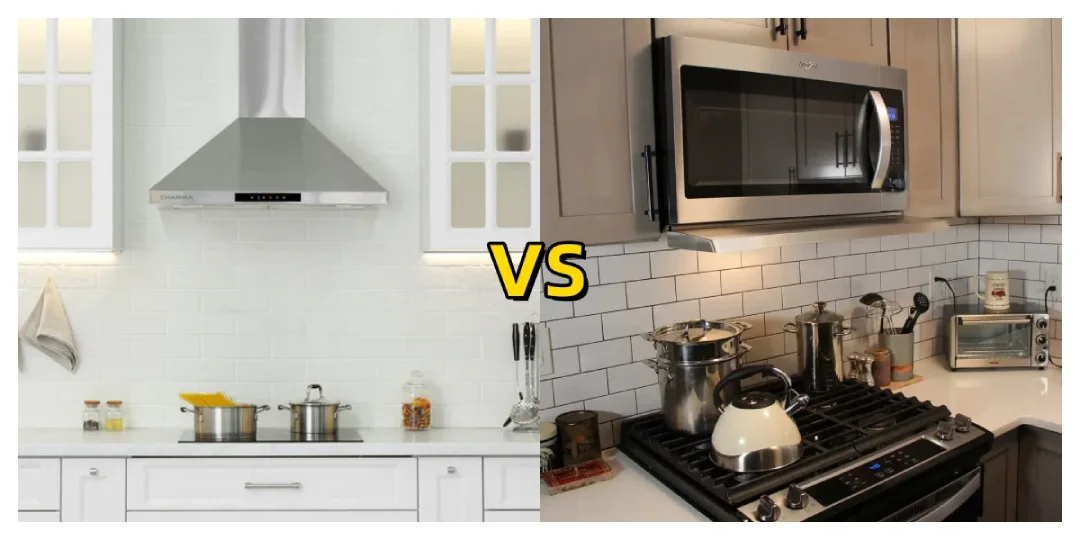
A few months after we moved into our new home, our above the range microwave went ka-poot! We spent a few weeks debating whether to fix the microwave, replace with a new microwave, or switch to a range hood.
When it became apparent that repairing was not an option and that another microwave would likely run into the same issue, we narrowed our search to finding the right range hood.
It was at this time that the folks at Proline Range Hoods reached out to me and asked if we’d like to review one of their professional range hood models. Talk about perfect timing!
Appliance purchases are a big decision, so it’s important to know all the pros and cons of a range hood vs microwave. Keep reading to see our process for picking the right range hood, as well as why we chose NOT to install another over the range microwave.
6 Reasons a Range Hood Vent is Better than an Over the Range Microwave
A microwave may be a useful option to free up counter space in small kitchens or if you don't cook a lot. However, I’m assuming you probably DO cook often if you’re reading this post!
Here are key points to consider when deciding between a range hood and an over the range microwave:
1. Range Hoods Create More Space
Most over the range microwaves are flush with the bottom of your cabinets, providing limited space. Range hoods can accommodate taller pots and give you room to observe what you're cooking. This made a big difference in our kitchen!
2. Hood Vents Provide Better Capture
Microwaves are designed to tuck right into the space between your cabinets. This means that the front burners of your stove are not usually covered by the vent. A significant amount of smoke or fumes may escape.
By contrast, a range hood extends so that it creates a canopy over your entire stovetop and are able to capture far more exhaust.
3. Range Hoods are More Powerful
The fans in most over the range microwaves are between 300-400 cubic feet per minute (CFM) venting power. This may or may not be adequate for your stove and kitchen space.
To find out how many CFMs you need, there are a few easy calculations, depending on which type of stove you have:
- For electric stovetops — multiply the width of your stove by 10. For example, a 40″ electric stovetop requires a minimum of 400 CFM ventilation.
- For gas cooktops — add up the output of each burner (measured in BTUs — you can usually find this on the label on the back of your stove) and divide by 100. A 50,000 BTU range would require a minimum of 500 CFM ventilation.
Although the above figures show the minimum ventilation requirements, for best results, Proline Range Hoods recommends at least 600 CFM no matter what type of range you own. Most microwaves don’t meet these criteria.
If you frequently deep fry or cook Asian cuisines (which often require high heat), you’ll want to add 200-300 CFM to your minimum requirements.
Once I ran these calculations, I quickly realized that the microwave that came with our home did not meet the needs of our stove (which at 43,350 BTU requires at least 435 CFM). We also fry and stir-fry often in our kitchen. No wonder our microwave failed!
Which brings us to the next problem with an over the range microwave…
4. Microwaves are More Likely to Fail (and you lose 2 appliances!)
Why did our microwave fail? We originally thought it was an electrical wiring problem with our house that shorted out the appliance.
However, when we called a technician in to check it out, he explained that it is often unavoidable with over the range microwaves, due to their design.
When venting smoke, grease, etc. with a microwave fan, those contaminants essentially junk up the inner workings of your microwave. Over time, the buildup may cause the appliance to fail irreparably. And that means you’ve lost not only a microwave, but your kitchen vent as well!
A range hood is designed specifically for the task of venting cooking fumes out of your kitchen. Nothing else. And in this case, specialization makes all the difference!
5. Range Hood Vents are Easier to Clean
Remember how I said that dirty exhaust fumes and cooking grease make their way into your microwave? Well, it’s not very easy to clean all that. Scratch that…it’s impossible!
A quality range hood is designed for ease of cleaning. Our particular model features two removable, dishwasher-safe baffle filters.
My husband specifically looked for this type of filter versus a mesh filter (found on many microwaves and bargain range hoods sold at big box stores) because it is what he used on his food truck. With a baffle filter, grease condenses onto the filter so it can be wiped away with degreaser, instead of clogging up your ducts.
6. Hood Vents are Better for Frying
As mentioned above, frying and stir-frying creates more heat, steam, smoke and grease than most typical foods. If you regularly cook this type of high heat and/or high grease foods, more CPM power is needed than what a typical microwave vent can handle.
Range Hood vs Microwave: Our Kitchen Transformation
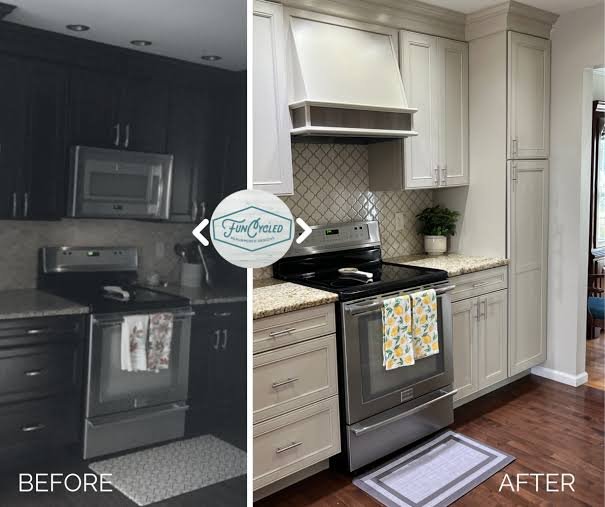
I’m actually going to show you two “before” pictures of our kitchen. The first is what our kitchen looked like when we moved in to our home a couple years ago:
If you look at the ceiling, you can see staining above the stove area. That’s from years of inadequate ventilation — so much grease and smoke ended up outside the vent that it discolored our ceiling!
Painting the cabinets made a huge difference in brightening up the space. However, we noticed that those white cabinets were quickly getting dirty from cooking grease (my husband likes to fry foods often).
That’s why it was more crucial than ever that we get a proper range hood installed immediately!
We ended up choosing a 30″ wall range hood in stainless steel from Proline Range Hoods. With a 1000 CFM blower, it is more than enough venting power for our range. The extra power is perfect for us because my husband likes to fry a lot!
Not only does it give us the functionality we needed, it just LOOKS so much better! We haven’t even had a chance to replace the backsplash yet, but swapping in a new range hood makes it appear that we did a major kitchen renovation (even when we didn’t!)
The range hood installation for this model is pretty simple; if you have a helper and basic tools you can probably DIY it.
For us it was slightly more complicated because we had some wiring issues to fix before installation (unrelated to the range hood…the previous homeowner fancied himself an amateur electrician). We also hired our local cabinet maker to make room for our range hood so we had plenty of clearance over the stovetop.
However, if your over-the-stove space is open and ready to go, the installation is as simple as following the directions to bolt the range hood to the wall and plugging into your outlet. This was an easier installation process than the range hoods we researched at local home stores!
Why Proline Range Hoods?
If you’re looking for a range hood vent for your kitchen, I highly recommend Proline Range Hoods. That’s because range hoods are their specialty — it’s all they do!
Instead of going to your local home goods store where you might have a handful of options, at Proline there are hundreds of styles of range hoods to fit any kitchen layout.
If you’re not sure what type of range hood to choose, their professionals can guide you to the perfect model for your needs and budget. The process was easy and our range hood arrived quickly and in perfect condition! It was exactly what we wanted!
Did you like our blog?
Comments (0)
All comments are reviewed and approved by an admin before appearing publicly.
No comments yet - be the first to share your thoughts.