
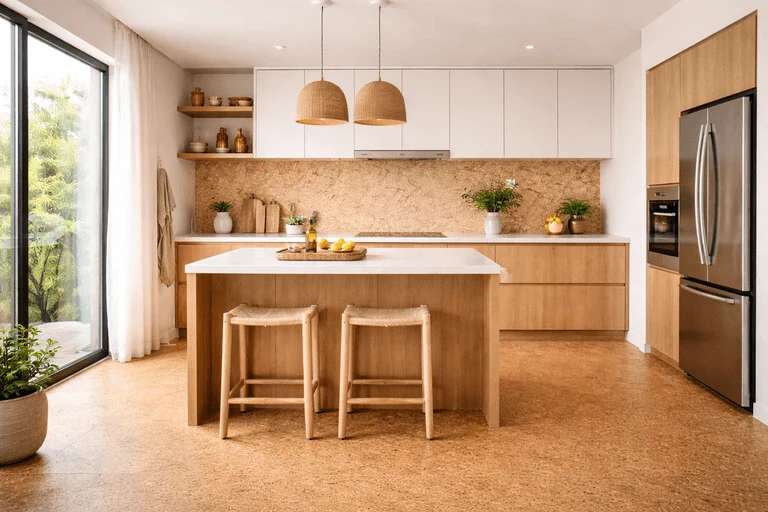
Cork flooring is one of the sustainable flooring solutions in today’s time. You must be knowing about corks, which is a natural material designed from cork oak trees.
There are many different types of cork flooring to choose from, as you undoubtedly well know. Some are simpler to set up, while others are better for the environment, and so on. Cork flooring is divided into two types: natural cork and engineered cork.
Benefits Of Cork Flooring
Before we get into the negatives of cork flooring, let’s go over all of the ways cork can help you save money and increase your home’s comfort. (We understand.) That is why you have come.
Works As An Insulator
Cork’s natural thermal characteristics make it a low-cost option to heating wood floors. Cork has an R-Value of 3.0 per inch of thickness, making it as warm as a mid-weight puffy jacket. To put it another way, without spending a fortune on radiant floor heating. You can save money on your utility bills!
Easy To Install
Engineered cork flooring planks, like many DIY wood floors, are often equipped with click-lock installation grooves, making them equally as simple to install as fake wood flooring options such as vinyl and laminate. You may install click-lock planks over existing floors exactly like snap-together tile flooring because they form a floating floor. And Ideal For the Do-It-Yourself Crowd
Renewable And Environmentally Friendly
Cork is one of the most environmentally friendly flooring alternatives available. Timeline of Cork oak trees to be harvested is every nine or ten years for up to two centuries.
Hardwood trees, on the other hand, require a long time to mature. That’s all there is to it once they’ve been cut down, you cannot harvest them again. As a result, cork is a very sustainable and environmentally friendly building material. When it comes to sustainability, even fast-growing softwood surfaces like pine or Douglas fir flooring can’t compare to cork!
Disadvantages of Cork Flooring
There are certain drawbacks to cork flooring, but they aren’t deal breakers in our opinion. However, you should be aware of potential cons in order to avoid unnecessary hassles in the future. Let’s have a look at some options for dealing with the drawbacks of cork flooring.
Cork Floors Are Susceptible To Fading When Exposed To The Sun
One of the most prominent drawbacks of cork flooring is its susceptibility to UV rays. Long-term exposure to direct sun can cause cork to fade. UV lamps have the same effect.
Cork Floors Can Be Dented Or Scratched By Blunt Or Sharp Objects
Sharp things can produce gashes, although dents and scratches aren’t a big deal. Sharp objects, heavy appliances, can pierce the cork flooring and cause damage. So, cork flooring is not the ideal option, if you’re seeking for dog-friendly flooring.
Cork Flooring Needs To Be Sealed And Maintained On A Regular Basis
Every few years, cork floors must be maintained and resealed. Cork flooring with worn varnish is more prone to water damage, and without sealing, they can disintegrate. However, a no-shoes policy, regular sweeping, vacuuming, and mopping with a damp (but not wet) rag can often extend the life of your sealant.
Conclusion
That was an in-depth overview of the benefits and drawbacks of cork flooring. We hope you’ve learned everything there is to know about cork flooring, and if you’re ready to move forward (or just want to speak about which flooring is best for you), start by looking for a local flooring store in your region. Local flooring stores are more concerned with floors than we are.
Did you like our blog?
Comments (0)
All comments are reviewed and approved by an admin before appearing publicly.
No comments yet - be the first to share your thoughts.