
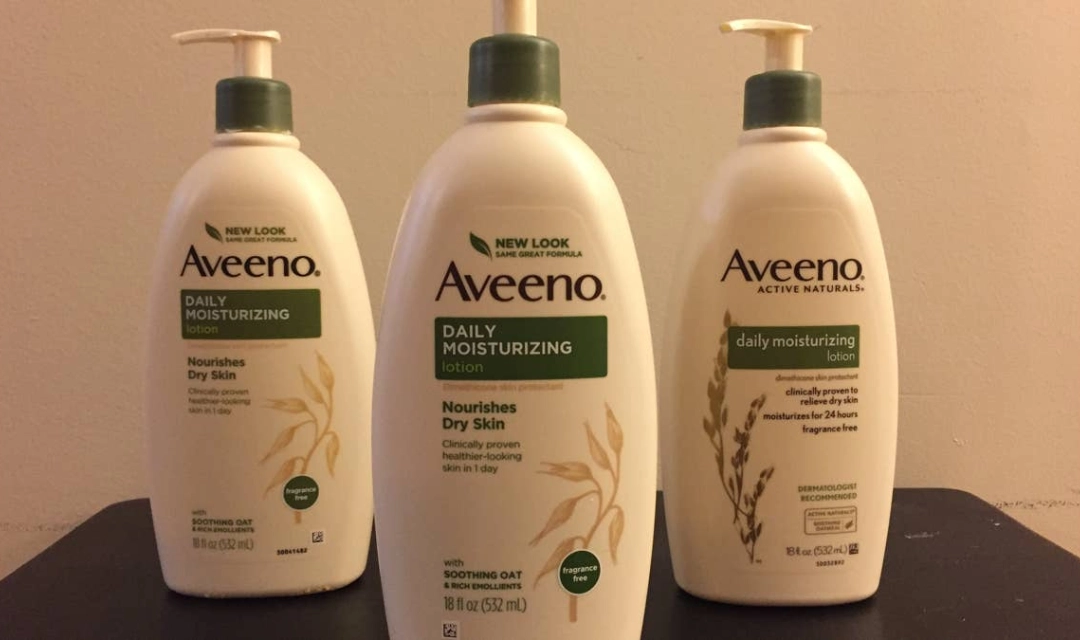
Two Aveeno products, almost the same price, sitting a few feet apart in the same aisle.
Aveeno Baby Daily Moisture Lotion costs about $12.62 for 18 fluid ounces. It has no active ingredient and no Drug Facts panel. It is a cosmetic.
Aveeno Eczema Therapy Daily Soothing Body Cream costs about $12.79 for 7.3 ounces. Its active ingredient is colloidal oatmeal at 1 percent, its stated purpose is skin protectant, and it carries the full over the counter drug sections including a warning to stop use and ask a doctor if symptoms last more than seven days. It is a registered OTC drug with an NDC number.
Same brand, same oat imagery on the front, nearly the same shelf price, and one of them is legally a medicine while the other is lotion. If you are buying Aveeno for eczema, only one of those is indicated for it, and it is the smaller, more expensive-per-ounce one.
That distinction runs through this entire Aveeno review. A quick note before anything else: this is not medical advice. Eczema is a medical condition, and if a rash is spreading, weeping, infected, or not improving within a week, that is a doctor's question rather than a shopping question.
What colloidal oatmeal actually is
Colloidal oatmeal is oat kernel ground extremely finely and suspended so it stays dispersed in water. It is not a marketing ingredient and it is not oat flour.
The reason it matters is regulatory. Colloidal oatmeal is a recognised over the counter skin protectant active ingredient in the United States, which means a product containing it at an appropriate concentration can be sold as a drug with a stated indication, rather than as a cosmetic that can only claim to moisturise.
That regulatory status is why Aveeno Eczema Therapy can legally say it helps relieve minor irritation and itching from rashes and eczema, while Aveeno Baby Daily Moisture Lotion can only say it soothes and restores the skin moisture barrier. The first is a drug claim. The second is a cosmetic claim. The difference is not marketing tone, it is law.
Practically: if you want the product with an actual indication for eczema, look for the words active ingredient and a percentage. If a product does not list one, it is a moisturiser, however many oats are on the packaging.
Prebiotic oatmeal is a different claim entirely
Here is where it gets genuinely confusing, and it is worth checking yourself on any bottle you own.
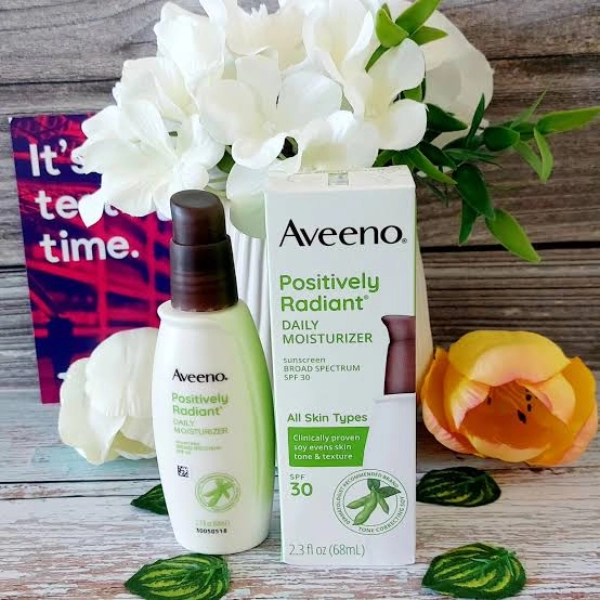
The Aveeno Baby Daily Moisture Lotion listing describes its oat content as Prebiotic Oatmeal in the product title and as nourishing oatmeal in the feature copy, while older naming for the same line used Natural Colloidal Oatmeal.
Prebiotic is a claim about feeding beneficial skin microbes. Colloidal is a description of particle size and dispersion, and it is the term that carries regulatory weight. They are not synonyms, and a shopper reading the front of the bottle has no way to tell which one implies an active ingredient.
None of this makes the baby lotion a bad product. It is well rated and reasonably priced, which is covered below. It does mean that the oat on the label is doing different work on different products in the same range, and the only reliable way to tell is to look for the Drug Facts information.
Aveeno Eczema Therapy Daily Soothing Body Cream
Around $12.79 for 7.3 oz, roughly $1.75 per ounce. Rated 4.7 out of 5 from over 3,000 reviews.
The product to buy if eczema is actually why you are shopping. Active ingredient colloidal oatmeal 1 percent, listed as 10 mg per 1 mL, with the purpose stated as skin protectant and the label specifying mild to moderate eczema or as directed by a physician.
The inactive ingredient list is the other reason this is the stronger product, and it is worth reading because it is genuinely well built: water, glycerin, panthenol, petrolatum, dimethicone, cetyl alcohol, oat kernel oil, ceramide NP and oat kernel extract.
Three of those are doing real work. Glycerin is a humectant that pulls water into the stratum corneum. Petrolatum and dimethicone are occlusives that slow water loss out of it. Ceramide NP replaces one of the lipids that eczema-prone skin is short of. That is a coherent humectant, occlusive and barrier-lipid combination rather than a list assembled for the label.
Note the labelled warnings properly, because they are the part people skip. Stop use and ask a doctor if the condition worsens, if symptoms last more than seven days, or if they clear up and then return within a few days. That is not boilerplate. Eczema that is not responding in a week needs assessment, and a stronger prescription option may be appropriate.
Aveeno Baby Eczema Therapy
The infant version of the same formulation approach, and also a registered OTC product with colloidal oatmeal as the active ingredient rather than a cosmetic.
If you are buying for a baby with eczema, this is the product, not the Daily Moisture lotion. They look similar, they sit next to each other, and only one has an indication. The National Eczema Association's seal appears on several products in this line, which is a recognition programme rather than a clinical endorsement, but it does at least indicate the product has been reviewed against their criteria.
For an infant under six months with any significant rash, see a paediatrician before treating it yourself. Infant eczema, cradle cap, heat rash and fungal rashes look similar to a parent and are managed differently.
Aveeno Baby Daily Moisture Lotion
Around $12.62 for 18 fl oz, about 70 cents per fluid ounce. Rated 4.7 out of 5 from more than 8,600 ratings.
A cosmetic moisturiser with no active ingredient, and judged as that it is a good one. More than 8,600 ratings at 4.7 is a genuinely large and favourable sample, far more meaningful than the handful of ratings most products in these reviews carry. No added fragrance, no parabens, no steroids and no phenoxyethanol.
At 70 cents per fluid ounce against $1.75 per ounce for the Eczema Therapy cream, this is the product for routine daily moisturising on skin that is dry rather than eczematous. That is a real and common need and this does it well.
The mistake to avoid is using this as eczema treatment because it is cheaper and from the same brand. It has no active ingredient and makes no such claim. Buying 18 ounces of the wrong product is not better value than buying 7.3 ounces of the right one.
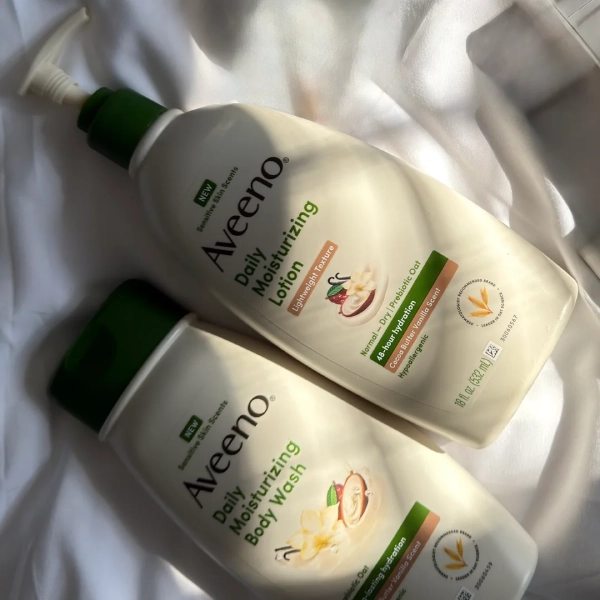
Aveeno Daily Moisturizing Lotion, the adult original
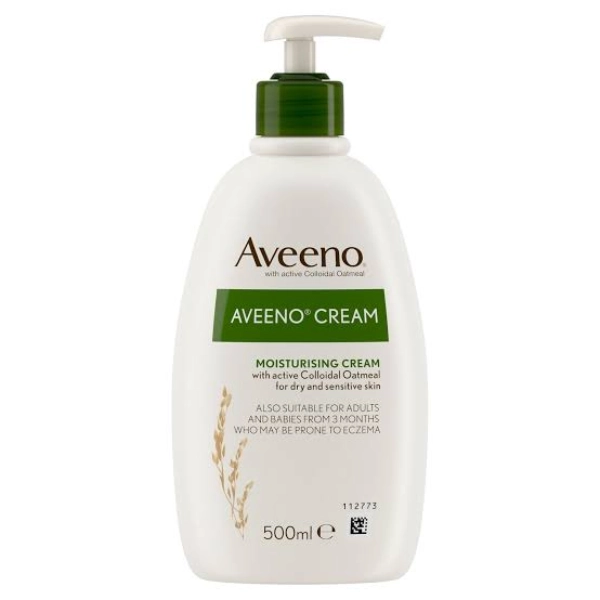
Around $12.62 for 18 fl oz, commonly sold in multipacks including an 18 oz two-pack with a 2.5 oz tube.
The product that built the brand, and the sensible default for general dry skin. Same category as the baby version: a cosmetic moisturiser rather than a drug.
Two practical points on using any lotion of this type well, which matter more than brand choice. Apply within three minutes of getting out of a shower or bath, while the skin is still damp, because a humectant with nothing to draw on pulls water from deeper in the skin rather than from the surface. And a lotion is the lightest format: for seriously dry skin a cream or an ointment holds more occlusive and works better, which is why the Eczema Therapy product is a cream rather than a lotion.
Aveeno Restorative Skin Therapy and the oat repair range
A newer line positioned around barrier repair. Before paying the premium over the original Daily Moisturizing Lotion, check the back of the specific tube for two things: whether it lists an active ingredient, and whether it contains ceramides and petrolatum or dimethicone.
That is the honest test across this whole category. Barrier repair is a real mechanism and it is delivered by occlusives and barrier lipids, not by the word restorative. If the newer product has the same functional ingredients as the cheaper one, you are paying for the positioning.
Who owns Aveeno, as of this month
This has changed twice recently and the second change is days old, which is why no other review of this brand currently has it right.
Aveeno sat inside Johnson & Johnson for decades. In 2023 J&J spun off its consumer health division as Kenvue, taking Aveeno with it alongside Band-Aid, Neutrogena, Listerine, Visine and Rogaine.
Kimberly-Clark then agreed to acquire Kenvue in a deal valued at $48.7 billion. Shareholders of both companies approved it on 29 January 2026, with roughly 96 percent of Kimberly-Clark shares present voting in favour and around 99 percent of Kenvue shares voted at its meeting. The acquisition completed on 2 November 2026. The combined company is headquartered at Kimberly-Clark's base in Irving, Texas, while retaining a significant presence at Kenvue's locations.
A small detail that illustrates how slowly packaging catches up with corporate reality: the current OTC label for Aveeno Eczema Therapy lists the labeller as Kenvue Brands LLC and states the product is distributed by Johnson & Johnson Consumer Inc. of Skillman, New Jersey. So the tube in your bathroom may name a company two ownership changes behind the current owner. That is normal and not a counterfeit indicator.
Does new ownership matter to a shopper? Not immediately. Formulations do not change at closing, and an OTC drug formulation cannot be altered casually because the active ingredient and its concentration are part of what makes it compliant. What can change over the following years is which products stay in the range, pricing, and where it is distributed. Kimberly-Clark has signalled a significant restructuring following the deal, so if a specific Aveeno product is the one your skin tolerates, it is reasonable to keep an eye on availability.
The 2021 benzene recall, stated precisely
Search this brand and you will find headlines about Aveeno sunscreens being recalled for a carcinogen. The plural is wrong and the precision matters.
On 14 July 2021, Johnson & Johnson recalled five aerosol sunscreen products after its own internal testing detected benzene in some samples. Four of the five were Neutrogena: Beach Defense, Cool Dry Sport, Invisible Daily Defense and Ultra Sheer. Exactly one was Aveeno: Aveeno Protect and Refresh aerosol sunscreen.
Three things to understand about it. Benzene was not an ingredient in any of these products, it was a contaminant detected in some samples, and the company said the cause appeared limited to certain aerosol formulations. J&J stated that daily exposure at the detected levels would not be expected to cause adverse health consequences and recalled out of an abundance of caution. And the wider context was an independent pharmacy, Valisure, which had found benzene in 78 sun care products, with its testing detecting benzene in 27 percent of 294 batches, some exceeding the FDA's 2 parts per million limit by up to three times.
So the fair reading is that this was an industry-wide aerosol contamination problem rather than an Aveeno formulation problem, that one Aveeno SKU was affected, that it was pulled voluntarily, and that it was five years ago. It is not a reason to avoid Aveeno lotions and creams, which are a different manufacturing process entirely. It is a reasonable argument for preferring a lotion or stick sunscreen over an aerosol, from any brand, which is the conclusion most dermatologists reached at the time anyway.
How to shop this brand properly
1. Decide first whether you need a drug or a moisturiser. Eczema, dermatitis and persistent itch point to the Eczema Therapy line. General dryness points to the Daily Moisturizing line.
2. Check the back of the pack for the words active ingredient and a percentage. That single check tells you which category you are holding, and the front of the bottle does not.
3. Ignore the oat terminology on the front. Prebiotic, nourishing and colloidal are not interchangeable, and only one of them is regulated.
4. Compare cost per ounce, not pack price. Seventy cents per fluid ounce and $1.75 per ounce are both reasonable for what they are, but they are not the same purchase.
5. Choose the format by severity: lotion for mild dryness, cream for more, ointment for the worst. The brand sells all three and format matters more than the name on it.
6. Respect the seven day warning on the drug products. If it is not improving, see a doctor rather than buying a bigger tube.
Is Aveeno worth buying?
Yes, and it is one of the more defensible mainstream skincare brands, for a reason that has nothing to do with its advertising: part of the range is held to a drug standard rather than a cosmetic one, with a named active ingredient at a declared concentration and labelled warnings a cosmetic would never carry. That is a real, checkable thing in a category full of unverifiable claims.
The Eczema Therapy cream at roughly $12.79 for 7.3 ounces is the product worth knowing about, with colloidal oatmeal 1 percent plus a sensible glycerin, petrolatum, dimethicone and ceramide base. The Daily Moisture lotions at around 70 cents per fluid ounce are good value for ordinary dry skin and rated 4.7 across thousands of reviews. The newer premium lines need their ingredient lists compared against the cheap originals before you pay more.
The thing to actually take away: the word Aveeno on a bottle tells you almost nothing about what is in it. Turn the pack over, look for an active ingredient and a percentage, and buy the one that matches the problem you are trying to solve.
Did you like our blog?
Comments (0)
All comments are reviewed and approved by an admin before appearing publicly.
No comments yet - be the first to share your thoughts.