
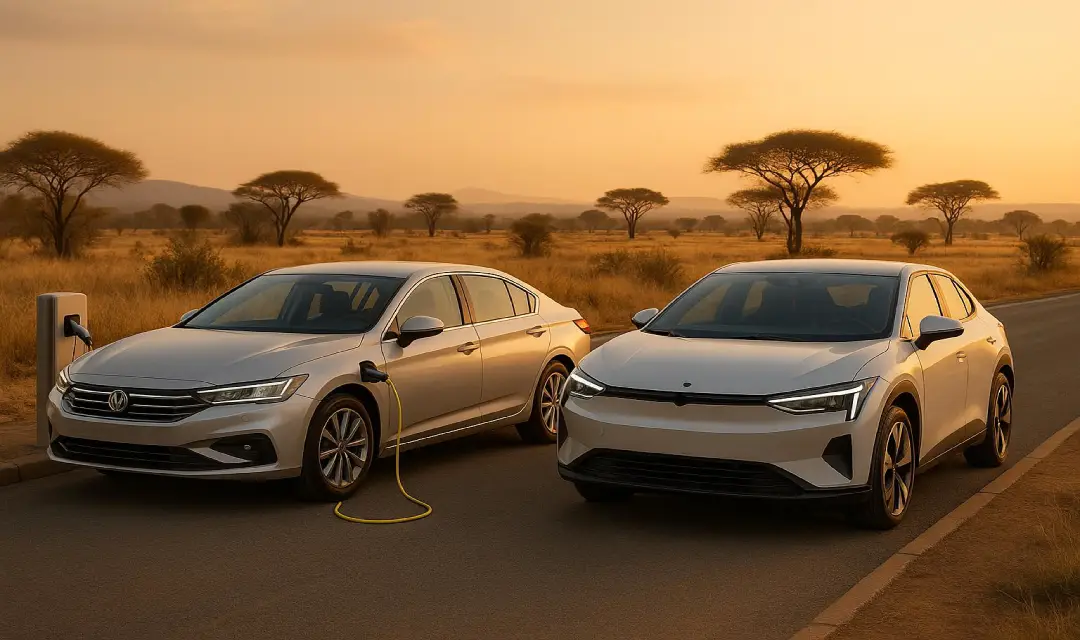
Nigerian Vehicle Market in 2026 grows in the double-digits, up by 66.8% YTD September, with GAC and Changan standing out as the two top brands to report yoy growth above 200%. The electrified segment remains relatively new, with several brands making their way into the rankings.
Medium term market trend
Nigeria’s vehicle market starts the series at 52,789 units in 2014, the year the Nigerian Automotive Industry Development Plan was launched. The plan was modeled on Brazil’s and aimed at encouraging local production, and nearly 30 licenses were issued within two years. Demand did not follow the policy ambition. The oil price crash and weak domestic demand pushed sales down 68.5% to just 10,446 units in 2017. A rebound in 2018 lifted sales 68.7% to 17,625 units and encouraged some manufacturers to set up small assembly plants, but it proved short-lived. Sales fell 20.5% in 2019, and the 2020 pandemic, with lockdowns and a renewed oil slump, added a further 34.7% decline. Over this period the market was shaped by oil-linked economic shocks, and each recovery was erased before it could be consolidated.
The years from 2021 to 2023 were a phase of steady but modest repair. Sales of 10,086 units in 2021 (+25.9%) were still slightly below the 2017 trough of 10,446 units, so the rebound began from a very depressed base. 2022 was a pause rather than a breakout, with sales edging up 6.8% to 10,774 units. 2023 brought a clearer step forward, with sales rising 23.4% to 13,299 units. Across the three years the market grew 31.9%, yet 2023 volumes remained 24.5% below the 2018 rebound level. Three consecutive years of growth established direction, but not yet scale.
Momentum strengthened markedly in 2024 and 2025. Sales rose 21.0% to 16,095 units in 2024, then jumped 47.5% to 23,740 units in 2025. The market added 7,645 units in 2025, nearly three times the 2,796 units gained in 2024, so growth accelerated rather than merely continued. The 2025 total is 34.7% above the 2018 rebound level and 135.4% above 2021, which makes it the first sustained move beyond the pre-pandemic recovery peak. Even so, volumes stood at only 45.0% of the 2014 level and remain low for Africa’s most populous nation, so the market is still rebuilding its base rather than operating at scale.
2026 outlook
YTD September 2026 sales reached 24,772 units, up 66.8% year on year. After nine months the market has already surpassed the full-year 2025 total of 23,740 units by 4.3%, so 2026 will finish above 2025 whatever the final quarter delivers. YTD volumes are also 53.9% above the full-year 2024 result and 40.6% above the 2018 rebound level of 17,625 units. They exceed every full-year total in the 2017–2025 series. Growth has accelerated from the 47.5% recorded in 2025, with the pace up by 19.3 percentage points, so momentum is clearly building rather than leveling off. The market is moving from recovery into a genuine expansion phase.
The 2026 expansion is broad-based but uneven. Of the 20 ranked brands, 12 are growing, 7 are declining and 1 is flat, and seven of the growing brands are expanding faster than the 66.8% market rate. Demand conditions are strong enough to lift most of the field, yet the gains are concentrated in the upper tiers, while a cluster of lower-ranked names is losing volume in a market growing by two-thirds. The competitive environment is rotating: share is moving toward brands posting triple-digit growth. The nine-month result leaves the remainder of 2026 as a question of how far the year exceeds 2025 rather than whether it does. The market's history of sharp reversals in 2017, 2019 and 2020 nevertheless shows how quickly conditions can change, which makes the current sequence of consecutive annual gains all the more significant.
Brand performance
- Innoson +105.0%
- Toyota +24.9%
- GAC +247.2%
- Chery +19.2%
- North +191.3%
- Kia +15.4%
- Changan +216.7%
- Hyundai -1.5%
- Jetour +340.5%
- MG +8.4%
- Suzuki +107.5%
- Nissan +2.6%
- Mitsubishi -17.1%
- Isuzu -8.1%
- Peugeot -9.9%
- Tata -25.0%
- Renault -48.6%
- Mercedes 0.0%
- Jac +70.5%
- Ford -47.4%
The ranking splits into a high-growth group and a group that is growing slowly or shrinking. Jetour (+340.5%), GAC (+247.2%), Changan (+216.7%) and Nord (+191.3%) lead on growth, each expanding at three to five times the 66.8% market rate. Suzuki (+107.5%) and Innoson (+105.0%) more than doubled, and Jac (+70.5%) also outpaced the market. Innoson stands out because it leads the ranking while still growing at more than one and a half times the market rate, whereas GAC at third place adds a second large brand with very fast growth. The upper ranks are being reshaped by the quickest risers, not just defended by incumbents.
Brands that grew but below market pace lost relative share. Toyota (+24.9%) holds second place, but its growth is well below the market rate, and Chery (+19.2%), Kia (+15.4%), MG (+8.4%) and Nissan (+2.6%) show the same pattern, growing in absolute terms while falling behind the market. Nine of the top ten brands are growing, and Hyundai (-1.5%) is the only decliner in that group, so the top half of the ranking is broadly healthy even where it is lagging the market.
Weakness concentrates in the lower half of the table. Ranks 13 to 17, Mitsubishi (-17.1%), Isuzu (-8.1%), Peugeot (-9.9%), Tata (-25.0%) and Renault (-48.6%), all declined, an unbroken run of five brands losing volume. Renault and Ford (-47.4%) are the weakest performers, each losing close to half their volume in a market that is up by two-thirds. Mercedes (0.0%) is flat, so it too is losing share as the market surges. The ranking implies a clear redistribution: volume is being pulled away from the lower-ranked, declining brands towards fast risers, and the pressure on those declining names will intensify as the market keeps expanding without them.
EV Market Trend and Outlook
EV/PHEV sales are growing at 773.0% and now account for 2.2% of total industry sales. The growth rate is more than eleven times the 66.8% expansion of the overall market, and volumes are running at nearly 8.7 times their prior-period level. The scale of that expansion reflects a very small starting base, which the 2.2% share confirms: electrified vehicles are still a marginal slice of Nigerian sales, even as they become the fastest-moving part of the market.
The structural significance lies in direction rather than current weight. A share of 2.2% means the segment has little influence on total volumes today, yet growth of this magnitude changes its relative importance quickly if it is sustained, because each incremental increase in volume adds to share far faster than it does in conventional segments. Electrification is at the stage where it is establishing a foothold, not reshaping the market, and its development is just beginning to register in the industry’s structure.
For the wider industry, the implication is that EV/PHEV is an emerging competitive front rather than a volume driver. Total market growth of 66.8% is being delivered overwhelmingly by the rest of the market, so brands’ positions in 2026 depend primarily on their conventional ranges. The longer-term risk and opportunity lie in who builds early positions in the segment, because rankings set while volumes are small can shift quickly as the segment scales.
EV Brand Performance
- GAC New
- Jetour New
- Geely New
- BYD New
- Kia +86.7%
- Toyota New
- Dongfeng New
- Volkswagen -81.3%
- Zeekr New
- Xpeng New
The EV/PHEV ranking is defined by new volume. GAC, Jetour, Geely and BYD hold the top four positions, and all four are shown as New, which means there is no comparable prior-period volume in the data, so no growth rate can be assigned to them. The same applies to Toyota, Dongfeng, Zeekr and Xpeng. Eight of the ten brands are therefore new to the measurable ranking, and the segment’s 773.0% growth is being driven largely by entrants adding volume where none existed before.
Only two brands have a measurable growth rate, and they point in opposite directions. Kia (+86.7%) is the only established growth story, ranking fifth with volumes expanding at a healthy pace. That pace is well below the 773.0% segment rate, so Kia is gaining volume while ceding share to newer names. Volkswagen (-81.3%) is the only decliner, losing more than four-fifths of its prior-period EV/PHEV volume at a time when the segment is expanding rapidly, a sharp loss of position.
Links between the overall and EV rankings are visible for several brands. GAC and Jetour, first and second in the EV/PHEV ranking, are also among the fastest-growing brands in the overall table at +247.2% and +340.5%, so their electrified volumes coincide with strong total growth. Toyota, by contrast, grew 24.9% overall, and its EV/PHEV entry is new, so electrified volume is a fresh addition to a brand growing below market pace. The segment’s competitive structure is fragmented and still forming, with no single established leader and top positions occupied by brands that had no comparable prior-period base.
Analysis and Outlook
Nigeria’s market has passed through three distinct phases: a policy-led decline from 52,789 units in 2014 to 10,446 units in 2017, a volatile period of failed recoveries through 2020, and a six-year run of consecutive growth that has lifted annual sales to 23,740 units in 2025 and 24,772 units after nine months of 2026. Growth rates have stepped up from 6.8% in 2022 to 47.5% in 2025 and 66.8% YTD in 2026, a clear acceleration. The market has already exceeded every full-year total since 2017, but it still sits at less than half of its 2014 level, so scale remains the central limitation.
The brand picture shows that growth is being captured selectively. A small group led by Jetour, GAC, Changan, Nord, Suzuki and Innoson is expanding at rates that dwarf the market, while Toyota, Chery, Kia and MG grow below market pace and a lower-ranked group, including Renault, Ford, Tata and Mitsubishi, is shrinking outright. In a market growing by two-thirds, these declines amount to a sharp loss of position that will be hard to reverse without a change in approach.
Electrification adds a second layer of competition. At 2.2% of the industry, EV/PHEV is still small, but its growth of 773.0% and a ranking dominated by new entrants show that the segment is being built from scratch. Kia is the only established brand with a measurable positive trajectory, and Volkswagen the only one with a measurable collapse.
Three commercial conclusions follow. First, the volume opportunity is real and accelerating, but it rewards brands able to scale quickly, as the strongest performers show. Second, brands losing volume in a rising market face a structural problem, not a cyclical one, since the demand pool is growing and they are not capturing it. Third, the market's history of sharp reversals means current momentum should be treated as an opportunity to build position now, with EV/PHEV offering the clearest chance to secure early share while the segment is small and rankings are still open.
Did you like our blog?
Comments (0)
All comments are reviewed and approved by an admin before appearing publicly.
No comments yet - be the first to share your thoughts.