
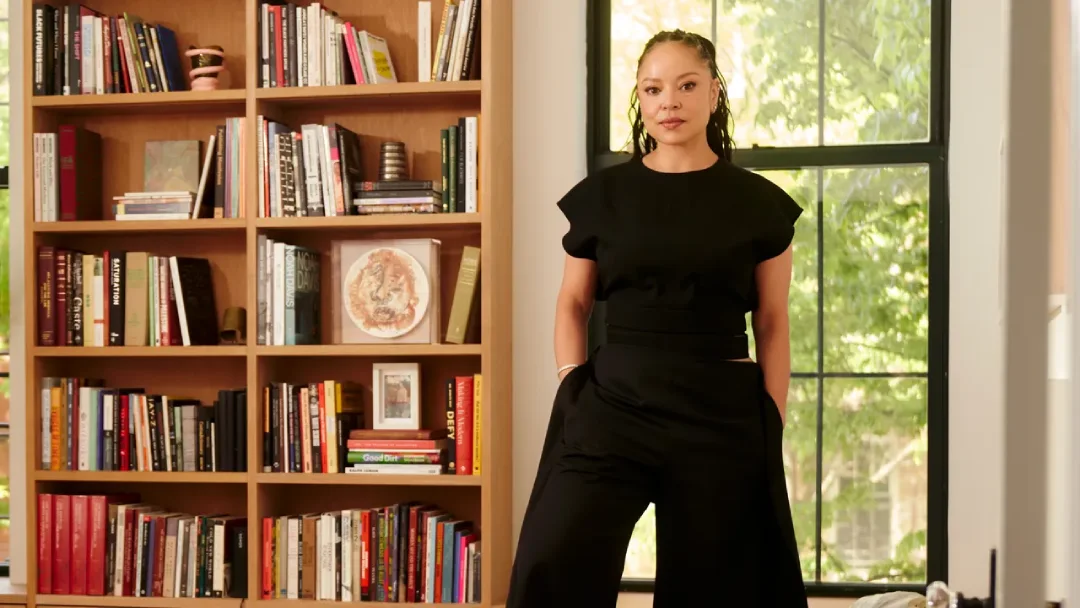
The mirrors came into Joeonna Bellorado-Samuels’s Clinton Hill apartment the way a difficult artwork might enter a gallery: with some complications. The stairs had been mismeasured, requiring scaffolding to be erected at the last minute to haul roughly 10-foot panes of glass through a window. “The neighbors were not used to that,” she says with a laugh. Luckily taken in stride, the episode speaks to something essential about Bellorado-Samuels’s home: It is all about the viewing experience.
Bellorado-Samuels began her career in the art world at the Studio Museum in Harlem before joining Jack Shainman Gallery as an assistant to cofounder Claude Simard. Now a senior director, she has developed an appetite for friction that informs her new space as much as her work trajectory. The same impulse—evident in her itinerant gallery project, We Buy Gold, which plays on themes of art and commerce, drives her distaste for sofas, preferring chairs that are sculptural and funky. Who knew tension between staying seated and falling down could drive the design of a living room?
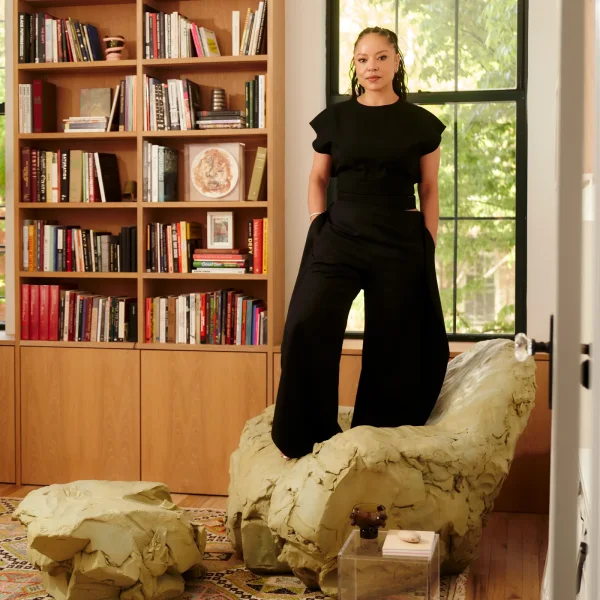
In the library the urethane foam, wood, and steel chair is by Urs Fischer and the side table is by Saint Heron. The Turkish Kilim rug is from Etsy. Elsewhere, pieces by Lorna Simpson, Gaetano Pesce, and a ceramic by Bellorado-Samuels are featured—among others. The window treatments are solar shades by The Shade Store and the walls are painted in Decorator’s White by Benjamin Moore.
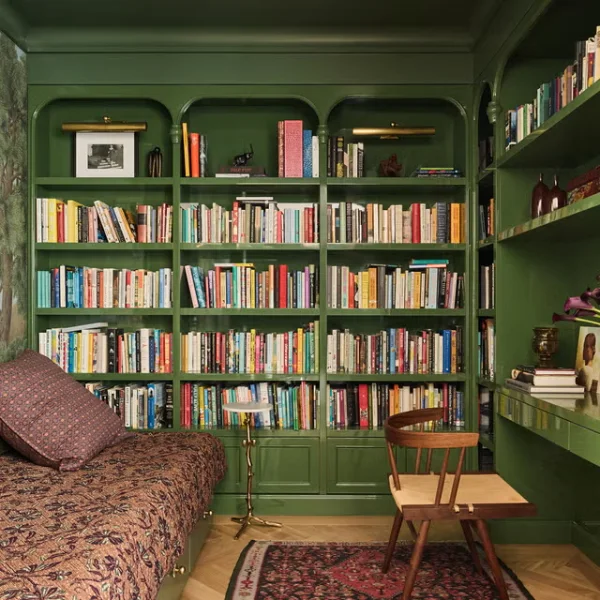
On the library wall the artwork is by (top, left to right) Joe Guerrero, Paul Anthony Smith, Charisse Pearlina Weston, Chioma Ebinama, William Rhodes, Malick Sidibé, Barkley L. Hendricks, Felipe Baeza, William Cordova, Charisse Pearlina Weston, Barkley L. Hendricks, William Rhodes, Toyin Ojih Odutola and Kerry James Marshall.
Throughout the two-bedroom apartment, which Bellorado-Samuels renovated over the course of four years, the concept triumphs over comfort. There are the mirrors, of course, that line a wall at one end of the open-plan living area, adding dimension and reflecting the room and windows. In the extra bedrooms, storage was sacrificed in favor of wall space. In Bellorado-Samuels’s own bedroom, the television is stashed under the bed and works by Barkley Hendricks, Sadie Barnett, and Charisse Pearlina Weston take pride of place. The second bedroom was turned over to a custom bookshelf that took ten months to develop with a millworker, Paul Finsterwald, whom she met through the gallery.
That instinct to prioritize pieces with meaning and sentiment has roots in San Francisco, where Bellorado-Samuels grew up. Her father, Joe Sam, was a political activist and artist who often worked with found materials. “We would go to the train tracks and collect things for his art that would end up on the kitchen table,” she remembers. "There's a certain practice of care you develop in just loving objects and the things that you live with. All you need is a little bit of restraint and you're golden."
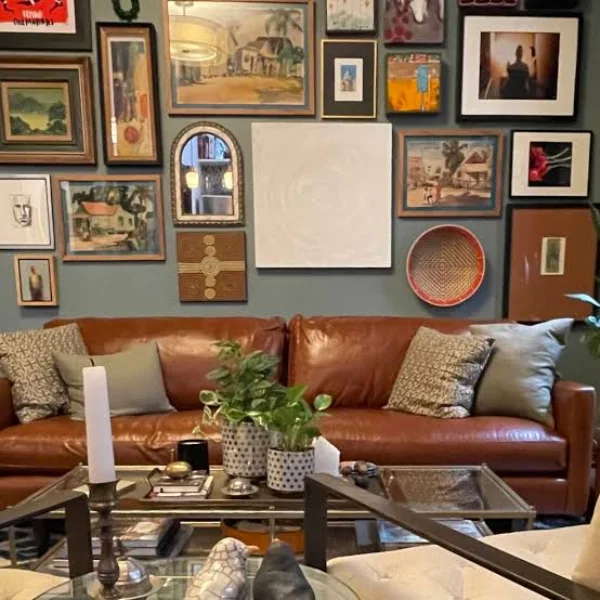
In the living room, the wall of mirrors is by HMH Architectural metal and glass and the daybed is from CB2. The vintage armchair is by Rodolfo Bonetto for Driade. The artwork (left) is by Sadie Barnette. The side table Bellorado-Samuels is a former Brooklyn school classroom from Bedford Galleries. It is topped with an antique women's cowry shell and fiber wedding veil from Papua New Guinea and a light sculpture by Nandi Loaf.
Her relationship to this apartment began with another ritual from childhood, when she and her mother would spend weekends touring open houses. The two revived the tradition one Mother's Day as Bellorado-Samuels found themselves on the hunt for more space. “I lined up a bunch of apartments to look at the weekend she came,” she says. “This was one of them.”
The building offered its own reasons to fall in love. The front dates to around 1850 and the rear to around 1900; it was once a women's home, with the rear portion built as an infirmary. It sat vacant for years before becoming the Bull Shippers Inn which then fell into disrepair, acquiring the atmosphere of a neighborhood haunted house. Eventually the property was bought, renovated, and divided into 26 apartments.
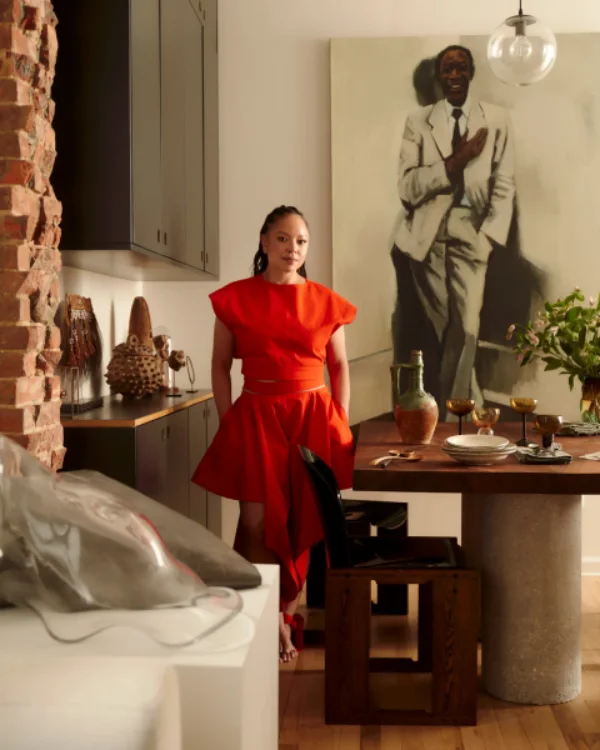
Bellorado-Samuels stands next to the dining table topped with glassware from Saint Heron, stoneware from Japan, and an antique pitcher sourced in Athens.
Bellorado-Samuels is drawn to the traces of those previous lives: the original façade, a strange little window no one can explain, and even the imperfect patchwork of the exposed brick she otherwise dislikes. “People who know brick tell me it’s a really terrible patch job, but I love how ragtag and random it is,” she says.
It's architecture that adds texture to the viewing experience. That, ultimately, is what makes the apartment feel less like a private gallery than a studied proposition for living with art. Bellorado-Samuels’s home doesn’t disappear behind her collection but pushes back, amplifies, complicates, and occasionally inconveniences it. “I like that in this space you can see all kinds of different art,” she says. "People think they can't live with sculpture—I love living with sculpture. Do you just want paintings of flowers? That's fine, but there are other things." Just remember to measure twice.
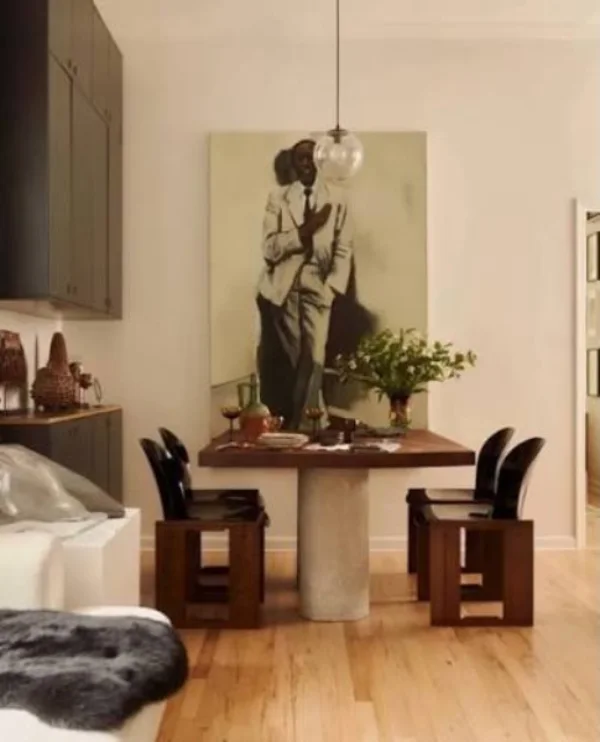
In the dining area, artwork by Lynette Yiadom-Boakye anchors the wall. Bellorado-Samuels designed the table with millworker Paul Finsterwald and it is surrounded with vintage chairs by Afra & Tobia Scarpa from 1stDibs. The artwork on the wall (left) is by Barkley Hendricks, and the sculpture below is by Charisse Perlina Weston.
Bellorado-Samuels is drawn to the traces of those previous lives: the original façade, a strange little window no one can explain, and even the imperfect patchwork of the exposed brick she otherwise dislikes. “People who know brick tell me it’s a really terrible patch job, but I love how ragtag and random it is,” she says.
It's architecture that adds texture to the viewing experience. That, ultimately, is what makes the apartment feel less like a private gallery than a studied proposition for living with art. Bellorado-Samuels’s home doesn’t disappear behind her collection but pushes back, amplifies, complicates, and occasionally inconveniences it. “I like that in this space you can see all kinds of different art,” she says. "People think they can't live with sculpture—I love living with sculpture. Do you just want paintings of flowers? That's fine, but there are other things." Just remember to measure twice.
Did you like our blog?
Comments (0)
All comments are reviewed and approved by an admin before appearing publicly.
No comments yet - be the first to share your thoughts.